
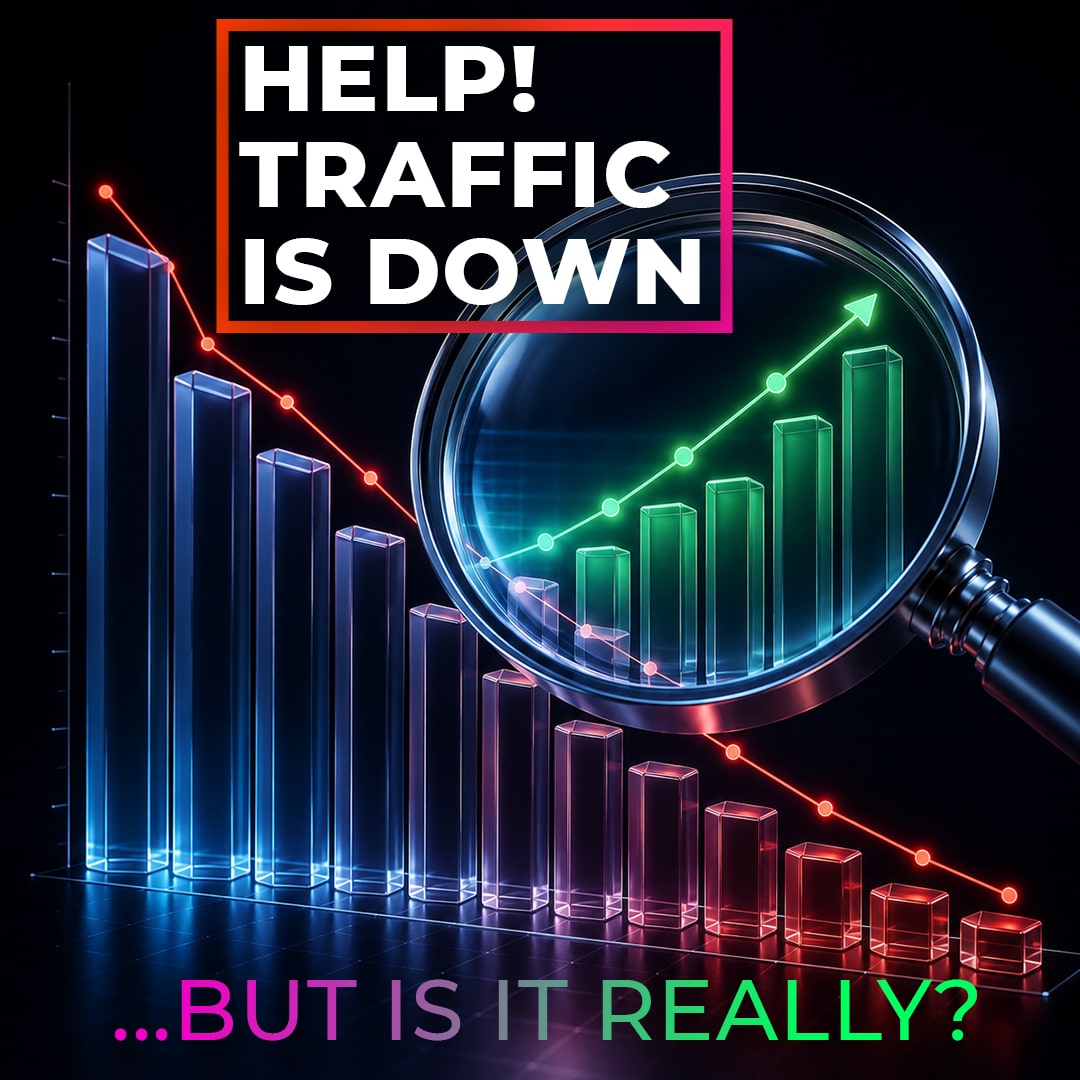
Your Traffic Is Down. Your Business Probably Isn’t.
Let me guess how you got here.
You opened your analytics dashboard, looked at the year-over-year traffic number, and your stomach dropped. Maybe it was down 40%. Maybe worse. And somewhere in the back of your mind, a little voice said the thing every contractor says when they see that number:
“This is why the phone isn’t ringing.”
Or maybe you got here because some agency cold-called you with the pitch of the year: “SEO is dead. AI killed it. But don’t worry… we’ve got a secret-sauce AI package that’ll get you ranked number one and help you dominate your market.”
Take a breath. Set the dashboard down. We need to talk.
The search game changed in 2026. That part is true.
Here’s what’s actually happening, and it’s happening to almost everybody.
Homeowners aren’t researching the way they used to. The old routine was Google, ten blue links, click around, compare websites. Now a big chunk of that research happens inside an AI conversation before anyone ever lands on a website. They ask the question, they get the answer, and by the time they touch your site, they’re most of the way to a buying decision.
The industry numbers back this up. Google Business Profile views dropped around 13% year over year across the board. And when AI results show up for local searches, they surface fewer businesses than the old map pack did… sometimes just one or two names instead of three.
So yes, the reported traffic looks ugly. Down big, year over year, on paper.
But here’s the part nobody selling panic will tell you:
The traffic that still lands on your website is worth more.
The tire-kickers, the researchers, the “just looking” crowd… AI is absorbing a lot of them now. What’s left is people closer to hiring. That’s why, across the contractors I work with, we’re seeing higher conversion rates and stronger buying decisions even while the traffic number falls. The same industry data shows it too: profile views down, but actions like direction clicks actually up.
Traffic didn’t die. The junk got filtered out.
The first question I always ask
When a contractor calls me worried about traffic, I don’t start with traffic. I start with this:
“How many phone calls did you get this time last year? Do you feel like you’re getting fewer calls now?”
Because traffic is just a metric. It’s a number on a screen. What you actually care about, what you’ve always cared about, is the phone. Am I getting enough calls? Could I be getting more? How do I get more leads?
Nine times out of ten, when we dig in, one of two things is true: traffic dropped but conversions held steady, or conversions actually went up. And in the rare case where leads really are down, the cause usually isn’t the algorithm. It’s that the marketing went quiet. Nobody’s been feeding the machine… no fresh content, no social activity, no time or energy invested with the marketing partner.
Marketing is not a fence. You don’t build it once and let it stand for twenty years.
Marketing is a lawn. Stop mowing it and it turns into a jungle.
The night the laptop came out
Not long ago I was sitting down with a fence contractor. Good cigar, good bourbon, good conversation. And like it always does, the talk drifted from the bourbon to the business.
I had my laptop with me, so we cracked it open and pulled up his metrics. His traffic was way down, and his reaction was instant: “Man, THIS is why I’m not getting any calls.”
So I asked him: “How many calls are you getting?”
He dug around, found some numbers. Then I asked the question that matters: “What did last year look like, same time of year?”
We talked it through. And come to find out… it wasn’t nearly as off as he thought. The scary number was the traffic. The number that pays his crew was mostly fine.
That’s what one metric does to you when you look at it alone. It lies by leaving things out.
But here’s where the night got useful. Instead of panicking about traffic, we looked at his competition. We found a competitor ranking for more keywords than he was, dug into which of those keywords actually made sense for his business, and built a six-month strategy to close that gap. Real market demand, real plan, real needle-movers.
And one more thing about competitor keywords, because I’ve seen this go the other way too. Another contractor once told me his competitor was ranking for a “shit ton” of keywords. He wasn’t wrong about the quantity. But when we researched it, most of the keywords driving that competitor’s traffic were educational searches and brand-name searches. Low-converting stuff. My guy had fewer keywords but better ones.
Quantity is a vanity number. Quality pays the bills.
The real bad guys
Now let’s talk about who actually deserves your frustration, because it isn’t Google and it isn’t AI.
It’s the agencies selling snake oil. The ones promising number-one rankings and market domination, then delivering cheap, AI-generated websites with no real architecture underneath. No strategy, no structure, no compounding performance. A website that looks fine in a screenshot and does nothing for you three years from now.
One of my favorite exercises is reading a competitor agency’s testimonials, tracing each one back to the actual website it’s talking about, and pulling the metrics on that site. You can see the lack of strategy from a mile away.
Here’s a real one. A contractor came to me debating whether to leave his marketing company. He actually had two websites in two different markets, run by two different agencies. When we pulled the numbers, the site with company A was generating solid traffic and real leads… about $1,500 worth of traffic value. The site with company B, the cheaper one? About sixty bucks.
He was paying less over there, sure. But saving money on the website was costing him the market.
Contractors are always looking to save a buck. I get it. I respect it. But a cheap website isn’t cheap. It just sends you the bill later.
So what do you actually do?
First, stay calm. If your phone is ringing, your schedule is full, and you’re happy with the size of your business, there is nothing wrong with that. Close this tab and go build fences.
But you didn’t read this far because you’re content. So here’s the honest version of “the move”:
Nothing is evergreen. No strategy is permanent, and every shiny new AI tool needs to be measured carefully before you bet your business on it. Not everything that glitters is gold. Sometimes that glisten you see is a little glisten of bullshit.
Before you sign with a new marketing company, talk to the people already using them. Trace the testimonials. Peek behind the curtain. Find out what actually drives that company, what systems sit behind their tools, and whether any of it aligns with your vision and your core values. If it doesn’t, it’s not a fit, no matter what the pitch deck says.
And keep your head straight about AI itself. It hallucinates. It gets things wrong. And it isn’t really some living, breathing intelligence anyway… it’s software built and steered by human engineers. AI makes a great assistant. It does research fast, it helps you move quicker. But just because you can generate a website in a few hours doesn’t mean that website will perform. Quality still comes from people. Real people, real experience, real proven results.
AI is not the end-all answer to your marketing. You need a real marketing partner with a real brain, one that can connect with your business, your mission, and your values, and manage a real strategy over time.
Before you go ape on your marketing company
Remember this: traffic, sessions, users… those are vanity metrics now, more than they’ve ever been. The search game changed, especially this year.
The number on the dashboard dropped. That doesn’t mean your business did.
Find someone who will dig deeper than the scary number. Someone who asks about your phone calls before your pageviews, who studies your actual competition and your actual market, and who builds for compounding growth instead of a screenshot.
Not just traffic. Results.